 A lot of people compare The Ghost Writer to Chinatown in its grasp of paranoia and political corruption, but the most obvious reference point to me seems to be Hitchcock’s The 39 Steps and its subsequent pseudo-remakes. An unsuspecting nobody with a smidgeon of wit takes on a job that gets him in over his head as he stumbles into an enormous political controversy, putting him in immense danger. He is tailed by faceless henchmen, gets to the bottom of a murder mystery, and even has a tense, awkwardly funny meeting with a wickedly condescending and highly suspect intellectual in a manor on a remote estate. As far as story mechanics go, The Ghost Writer is a classical thriller in the best sense of the phrase. And yet it is strictly anti-Hitchcockian in its muted, unobtrusive visuals and methodical pacing. It’s drearily non-picturesque to the point of minimalism, and its absence of a hedged stylization is what sets it radically apart from its oft-noted predecessors. Politically current while still entirely old-fashioned, The Ghost Writer manages goofy fun in the name of genre, seriousness in the name of tone and content, and maturity in its rejection of the overwrought defeatism that has made Chinatown the ever-enduring hallmark of Polanski’s filmography.
Thursday, August 19, 2010
The Ghost Writer (Roman Polanski, 2010)
A lot of people compare The Ghost Writer to Chinatown in its grasp of paranoia and political corruption, but the most obvious reference point to me seems to be Hitchcock’s The 39 Steps and its subsequent pseudo-remakes. An unsuspecting nobody with a smidgeon of wit takes on a job that gets him in over his head as he stumbles into an enormous political controversy, putting him in immense danger. He is tailed by faceless henchmen, gets to the bottom of a murder mystery, and even has a tense, awkwardly funny meeting with a wickedly condescending and highly suspect intellectual in a manor on a remote estate. As far as story mechanics go, The Ghost Writer is a classical thriller in the best sense of the phrase. And yet it is strictly anti-Hitchcockian in its muted, unobtrusive visuals and methodical pacing. It’s drearily non-picturesque to the point of minimalism, and its absence of a hedged stylization is what sets it radically apart from its oft-noted predecessors. Politically current while still entirely old-fashioned, The Ghost Writer manages goofy fun in the name of genre, seriousness in the name of tone and content, and maturity in its rejection of the overwrought defeatism that has made Chinatown the ever-enduring hallmark of Polanski’s filmography.

Tuesday, July 13, 2010
Peeping Tom (Michael Powell, 1960)
 Michael Powell’s Peeping Tom furnishes a psychologically torturous explanation for its protagonist’s murderous impulses and on first glance the film is easily comparable to Psycho for charting new territory in the realm of psychological horror. But the footage that Powell places upfront of Mark as a child in the throngs of his father’s cruel experiments is only one part of a puzzle that has more to do with artistry than with trauma. Peeping Tom is about the mania of directing a film, and Powell begins his exploration of the medium’s underlying terror by putting us in the subjective position of our hero, who later talks of going on to be a director and who is reprimanded at his part-time job as a lurid photographer of women for making his pictures too artistic. This disconcerting opening, wherein the man holding the camera systematically murders a prostitute, makes clear the directed nature of the footage and consequently ignites all manner of thoughts concerning the act of viewing a film. But while we are called upon to ponder our own viewing habits, we are beckoned with greater urgency to understand the artist’s, and when we finally get a glimpse of the mysterious filmmaker, our first impression is of a withdrawn individual disinclined to interact with others.
What emerges is a portrait of a man who only intervenes in life when behind the comfort of his camera, whose tripod leg constitutes a clear phallic symbol and without which Mark feels emasculated. It is a direct meditation on the concept of director as both passive observer and active manipulator, while working in various meditations on sex, murder and the cinematic voyeurism that infuses them. We may at first feel in the security of Powell’s assumedly ‘objective’ camera when removed from the vantage point of Mark’s, but as the film progresses it is Mark instead of Powell who emerges as the film’s director; he more or less states that he has willed the events leading up to his own demise as he obsessively films everything he can. Powell bravely identifies with this tortured individual, whose series of grisly murders is, in his mind, the building blocks of a grand work of art that can only achieve fruition in his death. It is one of the great films about artists, and in the running parallels between a large film crew working on an up-and-coming hit and Mark’s own directorial ventures we see in the latter a personal intimacy and nurturing instinct absent in the former (auteur theory encapsulated). Mark’s murder of one of the film’s extras places a morbid irony on the idea of directing actors, and this crops up later when the studio film’s leading actress's reaction to the corpse (placed by Mark in one of the prop suitcases) invariably becomes an extension of her own performance within the film she’s making.
These dissolves of the line between art and reality as they apply to the voyeurism at the heart of the film medium are manifold, even among the notions the film raises about fear and sexuality and childhood trauma. Amidst this swarm of challenging ideas, what lingers longest is the horrific image of a demented perfectionist of an artist leaving corpse after corpse behind until he achieves the right result, which is almost as terrifying as the fact that we can’t help but sympathize with him.
Before Sunrise (Richard Linklater, 1995)
 When it comes to chronicling the ephemeral, Richard Linklater’s Before Sunrise falls somewhere in between the spiritual heights of the transcendental school of cinema and stark, neo-realistic accounts of the mundane. Leaning towards romantic precepts of destiny but never moving beyond the everyday frankness of conversation, Before Sunrise is more affecting than many of its imitators, many of them great, even as it comes close to outdoing its most obvious predecessors, Vincente Minnelli’s The Clock and Leo McCarey’s Love Affair, by depicting the love between its protagonists as evanescent rather than something to be instantly recognized and carved in stone forever. As in the aforementioned films (and the third act of McCarey’s Make Way for Tomorrow), Ethan Hawke and Julie Delpy’s daylong sojourn in Vienna is a catalogue of kind strangers and evocative places and uneasy wistfulness, and these beautiful elements in harmony with the character-enriching dialogue transform the film from a self-contained romance into a breathtaking ode to love in transit.
Wednesday, June 30, 2010
White Dog (Samuel Fuller, 1982)
 White Dog marks my third Fuller film because of my impulsive desire to see why there seems to be such a divide between the generally negative reaction to it I’ve observed among acquaintances and the overwhelmingly positive appraisals of it by several critics I greatly respect. It is noted in a DVD supplement that Paramount higher-ups objected to Fuller’s nakedly intense style: energetic tracking shots, crosscutting between extreme close-ups, and several low angles (not to mention how Fuller incorporates contemporary slow motion into his typically explosive style). I can only imagine, had the film been properly released, how much of a stir his technique would have caused in a period in Hollywood cinema I generally regard as tepid and conservative, descriptives that can also be applied to the country's political climate (Fuller himself remarked that Reagan and the Republicans had American morality by the balls, and the film’s censorship is one of the most egregious examples of pressure group intervention).
 White Dog to some seems like a no-brainer anti-racist film, a view no doubt enforced by Fuller’s blunt dialogue and metaphors, but I found it absolutely brutal. Comparing Fuller’s treatments of racism in both this film and The Steel Helmet, the latter attacks it on both a national and distantly personal level while the former concentrates its critique into something more primal and readily identifiable. The corruption of what we never fail to understand is an innocent and pitiable creature, or, more abstractly, nature as a whole, is possibly the most incisive dramatization of the ills of forcefully embedded racism because it so aptly and simply cuts through any apologetic nonsense about racism being a natural phenomenon. Whatever the common criticisms are against the film’s datedness, overacting or exploitation stylistics, Fuller’s uncanny skill at splicing together a streamlined performance for the titular German Shepherd so that we comprehend in its visage a reflection of humanity’s vices undeniably compensates for, and greatly transcends, these petty grievances.
Saturday, June 12, 2010
Out of the Blue (Dennis Hopper, 1980)
 I don’t know all that much about punk, but I’ll be damned if there’s a better movie about it than Dennis Hopper’s Out of the Blue, a harrowing film about a rebellious youth named Cebe (Linda Manz) whose alcoholic father (Hopper) is soon to be released from prison after a traffic collision that killed several children and whose misguided optimism for familial security withers and dies with his destructive behavior and the resurgence of repressed memories of abuse she suffered as a child. She recoils into herself as the film careens forward, not unlike the semi we see crashing into the school bus at the film's start, erupting in a blazing ball of nihilistic self-destruction. The grungy locations and use of non-actors imbue the film with a flashbulb cultural and historical relevance and Manz is such an affective performer that even the most conventional scenes—a counselor played by Raymond Burr lecturing Cebe on her delinquent behavior—are worth crying over. The film is so brutal that any proposed solution looks like childish didacticism in comparison to the real-life horrors of Cebe’s walled-in life and the final, fatalistic stab at punk poeticism achieves an elegiac inevitability that manages to transcend both manufactured defeatism and logical nonsensicality in how sadly perfect it is.
Wednesday, June 2, 2010
The Lusty Men (Nicholas Ray, 1952)
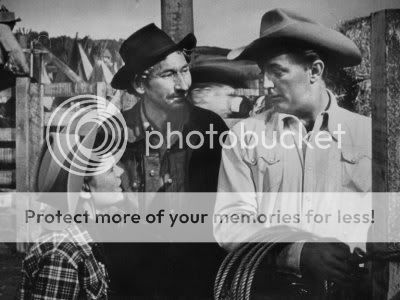 In The Lusty Men, Nicholas Ray anticipates the concise metaphor of the chicken run in Rebel Without a Cause with an entire two hours worth of suspense over a character’s choice to either jump early or ride to the death. It’s the fatalistic masculine ritual of the rodeo, and Ray explores it from several angles—thrill-seeking as metaphysical rush, danger-seeking as a quick route to fame and profit, and glory-seeking as male self-absorption. Robert Mitchum plays Jeff McCloud, a washed up rodeo star who partners up with Wes Merritt, played by Arthur Kennedy, a ranch-hand eager to make it big as a rodeo star himself. Susan Hayward plays his wife, Louise, in one of the most touching, understated female performances I’ve ever seen. Just about the only clearly thinking character the whole way through, Louise embodies Ray’s feminist leanings in her sympathetic foiling against the absurdity of macho ritualism. Ray never misses an opportunity to expose Wes for his misogynistic hypocrisy, lashing out at Jeff for mooching off his winnings while failing to acknowledge his own thankless dependence on his wife’s assumed domesticity and pleasuring himself with nightclub women without a blow to his conscience before hostilely confronting Jeff for kissing his wife.
If Wes is a brutish fame-seeker who becomes delusional about his rodeo skills and gambles away his winnings, then Jeff is harder to pin down, a wistful, tired-out man who exemplifies the lightly glimmering romance of the rodeo-circuit with all his failures behind him and who, like Dixon Steele and Jim Stark, desires some sort of family. He is seen at the beginning trekking in long shot through a rodeo graveyard and soon after goes to his childhood home in search of old belongings. It is one of my favorite Mitchum performances, confident and fragile and plaintive, and the ways Ray uses his depth of space to place him in various approximations to the other characters—triangularly in the context of Wes and Louise’s marriage and diametrically with Wes, his relationship to either ever in flux—gives the film an enrapturing formalism. The broader, poetic undertones erupt full-force when Jeff’s hard, masking exterior is shed to reveal his selfless, romantic motives and he rides off to a grand finish in a final spurt of his former glory—a heroic sacrifice, a tragic ode to what could have been between him and Louise, and a grand assertion of immortality.
“There never was a bronc that couldn't be rode, there never a cowboy that couldn't be throwed. Guys like me last forever.”
Friday, May 21, 2010
All That Heaven Allows (Douglas Sirk, 1955)
 Douglas Sirk is heralded as one of the slyest socially critical American directors of the fifties, though to be perfectly honest I find his targets in All That Heaven Allows to be obvious, easily compartmentalized concepts that feel only superficially representative of actual societal maladies. Rock Hudson's Ron Kirby stands as the handsome, earthy antithesis to materialism, in tune with nature and rock solid in his refusal to conform to society; his untainted ideology and handsome looks makes him some masculine ideal, less a character and more an archetypal savior. Jane Wyman stars as the disillusioned woman who falls in love with Kirby and who desires to break free from her social and domestic confinement but can’t quite summon the strength. Sirk launches attacks on class snobbishness and television sets and social prejudices with little subtlety or nuance (the daughter, espousing pop psychology and precociously toying with her glasses, is a blunt fifties construct that seems to trumpet to the viewer how socially relevant the film is). The structure of his love story, which reminded me of McCarey’s An Affair to Remember (possessing a remarkably similar ending), seems mechanical in its efforts to ensure a social statement at the expense of romantic passion. That said, Sirk works wonders with his visuals, telling his story in a static, Wyler-esque fashion that excels with framing devices and spatial expanses, but with an added flair for color, shifting between autumnal and wintry hues and using them to adeptly capture small-town America. Sirk seems to make his social criticisms as much through his color scheme as through his narrative, assigning cold greens to the club parties and textured reds and oranges to Kirby’s newly furnished mill. Nighttime juxtapositions between bright fluorescent orange and luminous blue moonlight achieve a romance almost over-suited to the story.
Thursday, May 13, 2010
Obsession (Brian De Palma, 1976)
 Obsession is Brian De Palma’s tribute to Vertigo, possessing less of the cosmic delirium of its source but having its own distinct eeriness. The first half hour is a mishmash of many Hitchcockian elements, many of which are from other films, but this tributary pastiche only serves as a launch pad for a story with as many haunting symmetries and parallels as its predecessor. A striking scene: Sandra’s transfixion on the painting of Elizabeth seems to mirror Judy’s transfixion of the museum painting of her ‘past’ self before we learn that she is really gazing at her dead mother. All throughout the film De Palma conflates the assumptions we make about this film as a Hitchcock rip-off with the gradual emergence of its own exclusive themes so that Freudian maternal longing becomes interfused with a more ghostly obsession, and that's but one example. The ending to Vertigo might be the most ambiguous conclusion to any of Hitchcock’s films, ironic because the last shot of Obsession depicts a conventional embrace set to Herrman’s score at its most romantic, implicitly revealing that all of the deceit has bubbled to the surface—Michael now knows all that has transpired and is finally reunited with his daughter—and making it a Hollywood capper if there ever was one, before it spirals into a carousel of psychological terror, the themes of incest, childhood trauma, and obsession now more apparent than ever. The freeze-framed ‘The End’ is gnawingly perverse.
Wednesday, April 21, 2010
Mélo (Alain Resnais, 1986)
 Many canonized directors often wind up endlessly lauded for a single work, and for Alain Resnais Last Year at Marienbad is that film. I had heard about it numerous times before ever once hearing about a single post-sixties film of his, or even his 1963 Muriel, made only two years afterwards. I suppose like many people, I started with Marienbad, deemed it the first experimental film I had ever seen that I simply could not get into, and then soon after billed Resnais as a pretentious French intellectual. The past few months have brought me up to speed on Resnais. I watched Muriel and found a painful, relevant, and all too real story, the shattered chronology a profound reflection of the characters’ shattered emotions and overall disillusionment. I then read up a bit about Resnais and among other things learned that he loves comic books, and came to a perception of him radically different from that I had formed after my novice viewing of Marienbad. A few weeks ago I revisited Marienbad and was completely absorbed; watching films on a laptop is not always an immersive experience, but I never once removed my eyes from the screen during the film’s entirely, viewing it as a hypnotic fairytale rather than a puzzle to be solved.
Today I watched Mélo, a film so far off from avant-garde snobbery I would imagine people whose only familiarity with Resnais is Marienbad would be genuinely shocked at its melodramatic restraint. The film consists of five or six lengthy scenes with a few interludes in between, a red curtain showing up three times to mark the end of each act. Associating Resnais primarily with montage, it is something of a surprise that Mélo is comprised of lengthy takes filmed with an inquisitive and at times interrogative camera. His mise-en-scéne reflects the 1920s in its cubist, but otherwise non-showy, set design, and to emulate the feeling of a theatrical production, he unnaturally dims and brightens his lights during shots to heighten the drama. The story is too conventional for anyone to take notice, a love affair leading to a suicide culminating in a confrontation between the widower and his wife’s lover, both of whom happen to be best friends. Reading what Bazin says of Renoir’s The River, he discusses how the film’s content is conventional to the extent that a novel (either its source material or yet another adaptation) would be subpar; the reason the film is a masterpiece is that Renoir goes beyond the conventionality of his dramatic conflict to craft a film more concerned with visual relationships and analogies and thematic conveyances of the eternal cycle of life.
Mélo, a film I believe to be greatly superior to The River, is a film based on a Henry Bernstein play I can’t imagine is much better than the Rumer Godden’s novel that formed the basis of The River. And yet instead of trying to transcend his source material by arriving at some kind of insight about life or painting over it with lush visuals or removing the necessity for linear plot, Resnais stays true and adheres so firmly to melodrama, the term in which the film’s title originates, that his film becomes a beautiful and more importantly unpretentious telling of a sort of typical story. Resnais directs his actors so carefully and shoots their scenes together so intimately, that the result is endlessly touching. Mélo is perhaps the zenith of what one might call an un-cinematic stage play, and yet, paraphrasing what Bazin said of Wyler’s The Little Foxes, it registers precisely as cinematic by nature of its restraint and asceticism and lack of formal exertion. This is a great film.
Tuesday, April 20, 2010
Juliet of the Spirits (Federico Felilni, 1965)
 If Fellini doused the story of 8 ½ with elements of the surreal then when it comes to Juliet of the Spirits, he submerges the film entirely in bizarre dreams and hallucinations and doesn’t let it come up for breath. What results is a cartoon under the guise of a prestigious art film. The genius of 8 ½ is that the subjective visions and flashbacks are on one level psychodrama and on another parodies of psychodrama, critiquing Guido as he tries to compartmentalize his life based on clichés of Catholic guilt and male fantasy. Juliet of the Spirits relies on the shopworn Fellini images and scenarios invoking similar themes—a school stage production of a martyr burned at the stake, a licentious father flying away with his young mistress and an exotic otherworldly sex party—but emboldens them until they become garish symbols and bases for the heroine’s day-to-day behavior and pseudo-meaningful Freudian determinants. Of course the film is so silly that it’s impossible to really put stock in any of them; the ending retraces 8 ½’s steps by accumulating all the arbitrary mysticism into one big hellish mass that Juliet must rise above or surrender to, except in this case there is no real thrust or structure or suspense. That there is no delineation between reality and mysticism and that it is all just a hodgepodge of overtly psychological projections relating to Fellini’s own marriage to Giulietta Masina may make it a work of genius to some, but I found it a self-indulgent bore, a vacuous showcase for Fellini’s brand of cinema without anything to latch onto. It is some of the best mise-en-scéne I’ve ever seen, and Fellini never fails as a ringleader of his imaginative ghostly carnival, but I honestly don’t think it amounts to much more than unrestrained excess.
Subscribe to:
Posts (Atom)