3/30/11 GOOD MORNING | Yasujirô Ozu | 1959
3/29/11 PANDORA AND THE FLYING DUTCHMAN | Albert Lewin | 1951
3/29/11 FACES | John Cassavetes | 1968
3/26/11 CERTIFIED COPY | Abbas Kiarostami | 2010
3/25/11 THE DARJEELING LIMITED | Wes Anderson | 2007
3/23/11 TRUST | Hal Hartley | 1990
3/19/11 UNCLE BOONMEE WHO CAN RECALL HIS PAST LIVES | Apichatpong Weerasethakul | 2010
3/18/11 SISTERS OF THE GION | Kenji Mizoguchi | 1936
3/14/11 SECONDS | John Frankenheimer | 1966
3/6/11 KELLY'S HEROES | Brian G. Hutton | 1970
3/5/11 THE KING'S SPEECH | Tom Hooper | 2010
3/5/11 EARTH | Aleksandr Dovzhenko | 1930
3/4/11 FREAKS | Tod Browning | 1932
3/3/11 MACBETH | Roman Polanski | 1971
Friday, April 1, 2011

Wednesday, March 30, 2011





Sunday, March 27, 2011
CERTIFIED COPY | Abbas Kiarostami | 2010
 Certified Copy is quite possibly the most enrapturing movie I have ever seen. It is simultaneously intellectual and deeply emotional, and unlike the more cerebral, high-concept manifestation of the puzzle film, Certified Copy is less about any abstract jigsaw than about the more fascinating puzzle of human behavior as it exists in finite space and time, eschewing the notion of overarching philosophy for something deeper, more mysterious, and ultimately extremely moving. No matter how you look at it you wind up with a Pandora's Box of emotional and thought-provoking consequences.
 If the couple is not a married couple then the film is about exploring the shared lives people can create without knowing each other, how their simulation of a marriage is a direct approach to an aesthetic argument of simulation and replication in art. If the couple is married, then the film is about a long-married couple attempting to recapture the springtime of their marriage both by simulating their honeymoon and by replicating themselves as they were fifteen years ago, creating copies of past lives that no longer correspond to their current selves. Or perhaps the time frames are shifting, the question of whether they are married or not can't even begin to be answered, and the couple transforms by some mysterious pirouette from new acquaintances into a married couple. But if this is the case, of course, then the continuity of their day-long dialogue becomes a surprisingly streamlined thread between two disparate time frames, so that the film is at once continuous and discontinuous. Even if you wish to forgo any such interpretation, you are still left with many hallmarks of Kiarostami's Iranian cinema (a restrictive camera that refuses to show us essential information lying outside the frame, pairing of professional and non-professional performers, various methods of implicating the audience in the narrative, etc.) and countless other points of entry (such as recurring visual motifs, the emotional rawness of the performances, references and allusions to the European art film of the past, etc.).
But what primarily matters is the feeling of existing with these people in a bounded temporality, replete with ravishing visual textures and moments of pure cinematic beauty. Kiarostami not only exercises his uncanny ability to depict the changes in visual atmosphere that transpire over the course of a day, but he also synchronizes these changes to the characters' constantly shifting emotional climate. Most of the intellectual ideas of the film, as I have so rudimentarily outlined them above, take form later, after mulling the film over in your mind (believe me, I have far from exhausted all options or meanings; in fact, the more I think about the film, the more convinced I am that the possibilities are endless), but its human and emotional truths unfold moment to moment within the film itself, and once it is over it is almost impossible to recapture them.
In other words, I believe Certified Copy has surmounted Playtime as my favorite film.
Friday, March 25, 2011
Exploring Cassavetes: SHADOWS
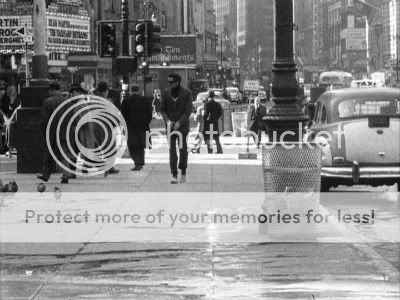 When I first watched John Cassavetes' Shadows about a year ago, I rightfully wrote that it was spontaneous, ahead-of-its-time, awkward, and unpolished. However, I also wrongfully compared it to Altman, Allen, and Scorsese, none of whom even begin to match what Cassavetes is doing in his debut film. Like in Altman films, the dialogue overlaps, but unlike in Altman films, the overlap is not calculated as being part of a style or aesthetic, and it serves a function of directing your attention to multiple things at once (think the dance hall scene early on in the film). Altman still maps his scenes with clear focal points, the surrounding noise intended to locate his main attractions in 'true-to-life' situations. I compared Cassavetes' Manhattan to Allen's, again a gross miscalculation. Allen's New York is cultured and upscale, populated by neurotic intellectuals with easily pinpointed psychological issues. There is no place in Allen's filmography for grime or poverty or ramshackle apartments. Shadows depicts a more subterranean New York, one of bad nightclubs and damp courtyards and overcrowded streets. Scorsese may offer the best point of comparison, if only because Cassavetes exerts a more clear influence on him than the other two, and yet Scorsese's vulgar naturalism serves a far more holistic and deterministic function than Cassavetes', which is always employed as a means of penetrating his unclassifiable and unpredictable characters.
On viewing Shadows a second time I realized that I cared far less about its aesthetic merits than I did the first time: the telephoto street views, the jazz solos, and overall 'look' of the film meant far less to me than did the strength of the performances. When before I admired the film for being open-ended, now I realize that there is no real narrative that makes such a clarification necessary. The entire film is loose, freeform, devoid of linearity or purpose, and all that exists is undefined and undefinable characters undergoing crises of self that are beyond heartbreaking. When before I felt compelled to judge Tony for his racism, which causes him to reject Lelia and propels her into emotional hardness, I now found myself feeling his confusion, disillusionment and awkwardness in the face of what is undoubtedly a striking revelation, that Lelia is, in spite of her appearance, not white. I viewed him as another character in the ensemble rather than as an intruder or negative supporting player. Likewise, I found more to understand in the rest of the characters and their complicated performances. Overall, I felt an accumulation of raw experience that excited and stimulated me, and the prior conception I had of it as a loose, jazzy, independent experiment fell apart entirely. A Woman Under the Influence and The Killing of a Chinese Bookie have taught me that forming conceptions of Cassavetes films is fruitless work.
Supplementing my viewing were the first sections of Ray Carney's book-length study of Cassavetes' films. Carney's devotion to Cassavetes is so passionate and exclusive that he finds himself unable to care for the rest of American cinema, which he consigns to an unwavering style that emphasizes fixed characters and transparent 'deep meanings.' Whereas most Hollywood films tell the audience what to think and how to feel, set tones and moods and emotional cues, and strive for legibility at all costs, Cassavetes' films are about shifting surfaces and frenetic behavior, plotlessness and unpredictability. This dichotomy between two schools of cinema is unfortunately and self-evidently simplistic. Carney refers to Welles and Hitchcock over and over again. He claims this is because their films are the most viewed examples that illustrate his argument, but this leads to further difficulties. First, the reader gets the impression that Carney's understanding of Hollywood cinema is confined to a mere handful of canonized classics and well-publicized names. Carney is at pains to tell us that all of Hollywood operates on certain precepts, but fails to go outside his few meager examples. Even more grating is his insistence that both Welles and Hitchcock subscribe to this directorial philosophy, when he only seems to focus on Citizen Kane and Hitchcock's 50s period. Given that Welles's style changed drastically after traveling to Europe, Carney appears to be committing the cardinal sin of consigning the director to his most overpraised masterwork.
Thankfully, this polemic ends when he begins to write about Shadows, but while he has many important things to say about the film, he ends up returning to the same endless contrasts. Carney perpetually finds it necessary to prop up the rest of 'Hollywood cinema' as a negative image to illuminate Cassavetes' genius, and these comparisons prove tiresome. Even more repetitious is his inexhaustible arsenal of metaphors and explanations that emphasize the chasm between the self and its external representation, the clumsiness of his characters as they attempt to perform and express themselves, the ongoing process of revision and improvisation as the characters adjust and readjust to new events and surroundings, and various other iterations of what is essentially the same thing: the characters in Shadows have no fixed identity and are always changing. There comes a point where the reader wishes that Carney would write more about the specifics of the film, as opposed to Cassavetes' overarching philosophy and how this philosophy is so breathtaking and unique.
This is not to say that Carney does not provide many valuable insights. He is perhaps too attached to Cassavetes for these insights not to come across as veiled adulations, but his knowledge of Cassavetes is certainly comprehensive and incontestable. I am hoping that his analysis of Faces, a film he seems to regard even more highly than Shadows, fares better.
Tuesday, March 22, 2011
Placing Movies: The Practice of Film Criticism (Rosenbaum)

As the film critic whose work is most readily accessible to me, thanks to the work he has put into making most of his writings available online, Jonathan Rosenbaum has become a remarkable influence on the way I view cinema. Part of his achievement, and part of what makes him so appealing to me, is in his aim of disentangling film as an art form from film as an industry. As but one of many examples of this polemic that shaped the way I look at film criticism, many of the attitudes that I had once unconsciously formed on the matter of canonicity in cinema, a subject broached in the other book of his I have read, Essential Cinema, were instantaneously debunked upon reading his searing indictment of the American Film Institute's Top 100 Greatest Films list in conjunction with his lengthy and thoughtful reevaluations of many so-called classics that had piqued my curiosity. This skeptical and politically conscious attitude made Ebert's Great Movie essays, pieces that often equate 'greatness' with fame and influence as opposed to thoughtfulness and aesthetics and that were once my model of ideal film writing, all but obsolete.
Of course Rosenbaum's effect on me has been far greater than merely shattering my simplistic perceptions of institutionally fostered concepts of 'greatness' and classicality. In addition to guiding my tastes toward relatively unknown directors, both domestic and abroad, and instilling within me a skeptical predisposition toward the powers that be (whether obvious emblems of corruption such as Hollywood big whigs or less obvious targets such as myth-making biographers and unknowledgeable academics), Rosenbaum has served as a wellspring of all kinds of artistic discourse in addition to a guidepost to other brilliant critics and specialized texts. His often heated and occasionally acerbic writing is offset by his honesty, his lack of conformity and his willingness to share personal and autobiographical information in order to situate his arguments subjectively and place himself on speaking terms, as it were, with the reader. Placing Movies, in covering a larger span of his career and in providing five separate introductory pieces to the different sections of his book, contains more confessions, offhand references to personal struggles, and first-hand accounts of correspondence with critics, directors and other professionals than do the cumulative pieces I have read selectively from his website and the total output of Essential Cinema.
Almost all possible objections are directed toward his selection and categorization of pieces under separate headings, which are structured in a way that turns his introductory pieces into a sequential narrative thread. Because most of the book is a provocation in itself and very little of the writing avoids being combative in some way, a section entitled 'Provocations' seems redundant, and some pieces could have easily been swapped. For instance, a piece on Welles's Othello included in 'Touchstones' is lacking in the way of critical analysis on the film itself and is instead a highly informative investigation into the film's recent restoration. Perhaps, then, the piece could have functioned better as a 'Provocation' (especially considering that it begins with a blunt attack on the tendency of Corporate America to exploit the deceased Welles for its own ends) than as a 'Touchstone.' Some of the denser essays have the quality of over-analysis, and when two or more are placed consecutively with no shorter reviews to act as buffer, one gets bogged down and starts to notice how frequently Rosenbaum repeats certain terminology and lines of argument.
However, these criticisms are minor when viewed in conjunction with the sheer breadth of critical discourse provided. Whereas Essential Cinema is mostly Chicago Reader columns, Placing Movies includes work from all across the span of Rosenbaum's career, not all of it aimed at evaluating films exclusively. Rosenbaum includes much of his writing on other critics, from Manny Farber to Roland Barthes, and one searing piece towards the end of the book takes on an entire disposition of political complacency that Rosenbaum argues has dominated in our view of the history of the cinema, and the Blacklist era in Hollywood in particular. Some of his reviews are expedient and trenchant, for example his Soho News piece on Raiders of the Lost Ark that packs in a plenitude of references, analogies and anecdotes in the brief space it occupies, and others are immense undertakings that take a more serious and research-oriented approach toward their subjects, such as the immense article on Raoul Ruiz that seeks incredibly to synopsize his prolific oeuvre and predominant directorial philosophy, even as Rosenbaum finds himself without access to much of his work. Some Reader pieces I had read before, for instance the analyses of Mélo and The Manchurian Candidate, grew considerably for me, and I believe that the former now most certainly warrants a re-watch.
My favorite piece by far is 'The Death of Hulot,' one of the most personally affecting of the collection that is mostly a lovely account of Rosenbaum's acquaintanceship with Jacques Tati during the early 70s. This intimate portrait is not merely a series of fond recollections; it is also a tragic narrative that helps us find where Tati's life and art intersect, and how his style of direction was in many ways an extension of his everyday persona. In this piece, Rosenbaum offers a kind of critical writing that is formulated not by research or by scrutiny, but by fleeting experience, and as such it appeared to me the most valuable and touching of the many pieces offered here. And yet, due to the prevalence of bias, subjectivity, and autobiography that plays a role in every one of these pieces, the entire book contains this sense of passion and emotion to some extent, and as such it has become an irreplaceable part of my collection.
Sunday, March 20, 2011










Thursday, March 3, 2011
MACBETH, Take Two (Polanski)
 Polanski's 1971 Macbeth is an entirely different beast than Welles's, directed with far less vigor but composed and interpreted with far more care. Polanski's alterations to the original text are preferable to Welles's simplistic reductions, and the pageantry accommodated by the budget is truly splendorous compared to Welles's slipshod reused sets. However, as a work of cinema, Polanski's film is vastly inferior. He encases all the action in detached wide-screen compositions and parcels half the dialogue into atonal voice-over. The on-location shooting slides into set-bound play-acting, and the only instances of intensity are to be found in the violent passages, which Polanski milks for all the gore he can credibly drain from his brutalized corpses. It is a 'Polanski film' in that it is as soporifically grim and pessimistic as only he can make it. It is a fine work, but it falls far short of Welles's cinematic aggression.
Saturday, February 26, 2011
MACBETH, Take One (Welles)
 Consensus seems unduly weighted toward the demeaning notion that Welles's 1948 Macbeth is but an amateurish experiment of little worth except to film schools. Watching it, I understood instantaneously why Godard and Rivette spent eight hours on a single day watching repeated screenings. It is the grandest synthesis of theater and cinema I have yet laid eyes on. The sequence in which Macbeth, plotting with his malevolent lady, mulls over his predestined murder of the king, shot from a fiercely low angle that is transfixed on the king's cavernous quarters engraved in the side of a craggy, gothic spire even as the silhouetted performers occupy two-thirds of the frame, single-handedly renders Bazin's analysis of the staircase murder in The Little Foxes obsolete. It is theater at its most grand and artificial, even as the filmic space transforms the hovering themes of guilt and psychological oppression into indelible images, the cavern of the king standing for a forbidden place in Macbeth's mind where he dares not go, a moral threshold to ascend and from which he can never return. The whole film is drenched in such soundstage imagery of gargantuan thematic proportions, and the chiaroscuro lighting that is Welles's trademark forms the textures, obfuscations, and oppositions that are at the heart of Shakespeare's play and this masterful interpretation of it. It is ripe for theoretical deconstruction even as it is infinitely more visceral and intense than Olivier in his tepidity could ever hope to aspire.
Thursday, February 24, 2011
Double Feature (Cukor and De Palma)

Most of the fun of Sylvia Scarlett (George Cukor, 1935) film lies in Cukor's theatrical acuity, his reliance on simple mid-level compositions and compressed space in total service to the performances and how he very quietly swivels his camera around his actors for maximum performative impact. Sylvia Scarlett is a bumpy ride in that it moves briskly and changes gears from scene to scene, Katharine Hepburn and her gender-bending heroine the focal point that draws the rest of the film's disparate elements into some kind of cohesion. It's an enjoyable 30s road movie, but because the film's apparently subversive elements were unable to win me over to the side of its most outspoken admirers, that's about all it remains to me.

I preferred Brian De Palma's Phantom of the Paradise (1974), a histrionic amalgamation of seminal metaphysical texts into a rock-'n-roll horror show. De Palma is like a trashy, tacky Godard, freely taking whatever he wants from the pantheon of pop culture to create something so energetic and visually ferocious that it hardly matters if it's amateurish, formless, or, in the long run, dispensable. Peering through its impenetrable outer shell of glossy wide-angle shots, split-screens, and frivolous scenery, one can still latch onto its classicist underpinnings and absorb the agony and the anguish of its Faustian protagonist, even as the absurdity flowers into infectious camp. It's just a lot of fun.
Wednesday, February 23, 2011
My Return to Blogging
I have returned from a long sojourn, during which I came to feel that regularly blogging, in addition to being fatiguing, was not worth my efforts. Capsule reviews can be catalogued on various forums and i am too nervous to publicize this site outside of its meager readership.
A worthy companion to Two-Lane Blacktop as an early-70s zeitgeist masterpiece of the existential anguish of fundamentally empty characters, here coping with Antonioni's favorite theme of modern malaise and the yearning for escape. As in Antonioni's The Passenger, the protagonist leaves his life behind to embark on a reckless odyssey that conjoins him with a similarly undefined woman. Their time together converges on a beautifully fragmented and disorienting scene of landscape lovemaking, as the film itself culminates in an extended reverie of breathtaking, picturesque destruction.
Duel in the Sun is a film simmering with volatile conflict: the clash between Texan rurality and encroaching industrialization, the heated confrontation between an old-world patriarchal rancher and his New-England-minded son, the heroine's exoticism at odds with Southern femininity and the painful coexistence of her unshakeable lust for a rotten scoundrel and her torturous yearning for civilized married life with his brother. The film is an odd production, Selznick emulating Gone With the Wind for more big-picture success with a lot of matte paintings and horse stampedes, while Vidor as a director seems far more attuned to the stylized intimacy that unfolds in the expressionistically lit interiors. The Technicolor seems all over the place and the acting is always at the same high pitch. If there's anything that keeps the film together it's the sense of romantic and emotional torture that seems to pang all the characters, no matter where they are, and every scene broils with so much passion that Vidor's grandest achievement is in his ability to channel it all into a climax that's more tense and electrified than all the scenes that precede it. The final image of two virtueless lovers drenched in sweat and dust and blood from each other's bullets is the ultimate hauntingly romantic capstone to one of the most unusual but breathtaking Westerns i've ever seen.
Capitalist competition gone haywire, miscellaneous Joes scattered around New York staring to the brightly lit Maxwell Coffee building as a heavenly monument to the wealth and success they all crave, every one of them having entered in a $25,000 slogan contest for the coffee conglomerate. It's a satirical conceit made depressing when considering Jimmy MacDonald has been submitting similar slogans in various contests for years, all in the hope that this will get him, his fiance and his mother, all barely scraping by in a dilapidated boarding house, somewhere just a little more comfortable. The misunderstandings that ensue when some mean-spirited co-workers forge a telegram informing Jimmy that he has won spark a farcical snowball of events full of the most trenchant digs at frivolous consumerism, corporate hierarchies, and commercial selectivity i've seen in any film, while the generally despondent but still resiliently optimistic conclusion is heartbreaking. A million times better than The Lady Eve and sure to get me coming back to Sturges in the near-future.
Ultra-slick ultra-modern semi-comic existential thriller—full of hard edges, gaudy colors, vertical blinds, and reflective surfaces—about a double-crossed man out to collect $93,000 from his former partner, and by extension the corporation he works for. Part of the beauty is how the ever-stoic Lee Marvin, with his hard, blocky features, blends into the architecture. The frequent flashbacks initially have the feel of rhythmic, jolting sensations, but as Marvin ravages his way through the company's top ranks, they come to thread together his encounters with the executives into inadvertent repetitions and catchphrases, highlighting the absurdity of each one's automatic reluctance to fulfill his simple request even after he has more than proven himself a serious threat. There are tons of doubling effects and thematic symmetries, all of which are complemented perfectly by the labyrinthine, right-angle geometry of Boorman's visual schema.
But alas, I find myself more immersed in cinema now than ever, consuming books, journals and films themselves at an alarming rate. I need a hermitage wherein I might calmly reflect on my recent thoughts and exploits without the frenzy of a message board. As such, this blog remains a diary, a journal, a day-by-day chronicle of what is on my mind, as I continue to sail the seas and weather the winds of cinephilia.
For today, I produce a small sampling of short film reviews I have penned over the last few months, many of which I take some pride in. Enjoy.
Zabriskie Point (Michelangelo Antonioni, 1970)
A worthy companion to Two-Lane Blacktop as an early-70s zeitgeist masterpiece of the existential anguish of fundamentally empty characters, here coping with Antonioni's favorite theme of modern malaise and the yearning for escape. As in Antonioni's The Passenger, the protagonist leaves his life behind to embark on a reckless odyssey that conjoins him with a similarly undefined woman. Their time together converges on a beautifully fragmented and disorienting scene of landscape lovemaking, as the film itself culminates in an extended reverie of breathtaking, picturesque destruction.
Duel in the Sun (King Vidor, 1946)
Duel in the Sun is a film simmering with volatile conflict: the clash between Texan rurality and encroaching industrialization, the heated confrontation between an old-world patriarchal rancher and his New-England-minded son, the heroine's exoticism at odds with Southern femininity and the painful coexistence of her unshakeable lust for a rotten scoundrel and her torturous yearning for civilized married life with his brother. The film is an odd production, Selznick emulating Gone With the Wind for more big-picture success with a lot of matte paintings and horse stampedes, while Vidor as a director seems far more attuned to the stylized intimacy that unfolds in the expressionistically lit interiors. The Technicolor seems all over the place and the acting is always at the same high pitch. If there's anything that keeps the film together it's the sense of romantic and emotional torture that seems to pang all the characters, no matter where they are, and every scene broils with so much passion that Vidor's grandest achievement is in his ability to channel it all into a climax that's more tense and electrified than all the scenes that precede it. The final image of two virtueless lovers drenched in sweat and dust and blood from each other's bullets is the ultimate hauntingly romantic capstone to one of the most unusual but breathtaking Westerns i've ever seen.
Christmas in July (Preston Sturges, 1940)
Capitalist competition gone haywire, miscellaneous Joes scattered around New York staring to the brightly lit Maxwell Coffee building as a heavenly monument to the wealth and success they all crave, every one of them having entered in a $25,000 slogan contest for the coffee conglomerate. It's a satirical conceit made depressing when considering Jimmy MacDonald has been submitting similar slogans in various contests for years, all in the hope that this will get him, his fiance and his mother, all barely scraping by in a dilapidated boarding house, somewhere just a little more comfortable. The misunderstandings that ensue when some mean-spirited co-workers forge a telegram informing Jimmy that he has won spark a farcical snowball of events full of the most trenchant digs at frivolous consumerism, corporate hierarchies, and commercial selectivity i've seen in any film, while the generally despondent but still resiliently optimistic conclusion is heartbreaking. A million times better than The Lady Eve and sure to get me coming back to Sturges in the near-future.
Point Blank (John Boorman, 1967)
Subscribe to:
Posts (Atom)