 Consensus seems unduly weighted toward the demeaning notion that Welles's 1948 Macbeth is but an amateurish experiment of little worth except to film schools. Watching it, I understood instantaneously why Godard and Rivette spent eight hours on a single day watching repeated screenings. It is the grandest synthesis of theater and cinema I have yet laid eyes on. The sequence in which Macbeth, plotting with his malevolent lady, mulls over his predestined murder of the king, shot from a fiercely low angle that is transfixed on the king's cavernous quarters engraved in the side of a craggy, gothic spire even as the silhouetted performers occupy two-thirds of the frame, single-handedly renders Bazin's analysis of the staircase murder in The Little Foxes obsolete. It is theater at its most grand and artificial, even as the filmic space transforms the hovering themes of guilt and psychological oppression into indelible images, the cavern of the king standing for a forbidden place in Macbeth's mind where he dares not go, a moral threshold to ascend and from which he can never return. The whole film is drenched in such soundstage imagery of gargantuan thematic proportions, and the chiaroscuro lighting that is Welles's trademark forms the textures, obfuscations, and oppositions that are at the heart of Shakespeare's play and this masterful interpretation of it. It is ripe for theoretical deconstruction even as it is infinitely more visceral and intense than Olivier in his tepidity could ever hope to aspire.
Saturday, February 26, 2011
MACBETH, Take One (Welles)
Consensus seems unduly weighted toward the demeaning notion that Welles's 1948 Macbeth is but an amateurish experiment of little worth except to film schools. Watching it, I understood instantaneously why Godard and Rivette spent eight hours on a single day watching repeated screenings. It is the grandest synthesis of theater and cinema I have yet laid eyes on. The sequence in which Macbeth, plotting with his malevolent lady, mulls over his predestined murder of the king, shot from a fiercely low angle that is transfixed on the king's cavernous quarters engraved in the side of a craggy, gothic spire even as the silhouetted performers occupy two-thirds of the frame, single-handedly renders Bazin's analysis of the staircase murder in The Little Foxes obsolete. It is theater at its most grand and artificial, even as the filmic space transforms the hovering themes of guilt and psychological oppression into indelible images, the cavern of the king standing for a forbidden place in Macbeth's mind where he dares not go, a moral threshold to ascend and from which he can never return. The whole film is drenched in such soundstage imagery of gargantuan thematic proportions, and the chiaroscuro lighting that is Welles's trademark forms the textures, obfuscations, and oppositions that are at the heart of Shakespeare's play and this masterful interpretation of it. It is ripe for theoretical deconstruction even as it is infinitely more visceral and intense than Olivier in his tepidity could ever hope to aspire.

Thursday, February 24, 2011
Double Feature (Cukor and De Palma)

Most of the fun of Sylvia Scarlett (George Cukor, 1935) film lies in Cukor's theatrical acuity, his reliance on simple mid-level compositions and compressed space in total service to the performances and how he very quietly swivels his camera around his actors for maximum performative impact. Sylvia Scarlett is a bumpy ride in that it moves briskly and changes gears from scene to scene, Katharine Hepburn and her gender-bending heroine the focal point that draws the rest of the film's disparate elements into some kind of cohesion. It's an enjoyable 30s road movie, but because the film's apparently subversive elements were unable to win me over to the side of its most outspoken admirers, that's about all it remains to me.

I preferred Brian De Palma's Phantom of the Paradise (1974), a histrionic amalgamation of seminal metaphysical texts into a rock-'n-roll horror show. De Palma is like a trashy, tacky Godard, freely taking whatever he wants from the pantheon of pop culture to create something so energetic and visually ferocious that it hardly matters if it's amateurish, formless, or, in the long run, dispensable. Peering through its impenetrable outer shell of glossy wide-angle shots, split-screens, and frivolous scenery, one can still latch onto its classicist underpinnings and absorb the agony and the anguish of its Faustian protagonist, even as the absurdity flowers into infectious camp. It's just a lot of fun.
Wednesday, February 23, 2011
My Return to Blogging
I have returned from a long sojourn, during which I came to feel that regularly blogging, in addition to being fatiguing, was not worth my efforts. Capsule reviews can be catalogued on various forums and i am too nervous to publicize this site outside of its meager readership.
A worthy companion to Two-Lane Blacktop as an early-70s zeitgeist masterpiece of the existential anguish of fundamentally empty characters, here coping with Antonioni's favorite theme of modern malaise and the yearning for escape. As in Antonioni's The Passenger, the protagonist leaves his life behind to embark on a reckless odyssey that conjoins him with a similarly undefined woman. Their time together converges on a beautifully fragmented and disorienting scene of landscape lovemaking, as the film itself culminates in an extended reverie of breathtaking, picturesque destruction.
Duel in the Sun is a film simmering with volatile conflict: the clash between Texan rurality and encroaching industrialization, the heated confrontation between an old-world patriarchal rancher and his New-England-minded son, the heroine's exoticism at odds with Southern femininity and the painful coexistence of her unshakeable lust for a rotten scoundrel and her torturous yearning for civilized married life with his brother. The film is an odd production, Selznick emulating Gone With the Wind for more big-picture success with a lot of matte paintings and horse stampedes, while Vidor as a director seems far more attuned to the stylized intimacy that unfolds in the expressionistically lit interiors. The Technicolor seems all over the place and the acting is always at the same high pitch. If there's anything that keeps the film together it's the sense of romantic and emotional torture that seems to pang all the characters, no matter where they are, and every scene broils with so much passion that Vidor's grandest achievement is in his ability to channel it all into a climax that's more tense and electrified than all the scenes that precede it. The final image of two virtueless lovers drenched in sweat and dust and blood from each other's bullets is the ultimate hauntingly romantic capstone to one of the most unusual but breathtaking Westerns i've ever seen.
Capitalist competition gone haywire, miscellaneous Joes scattered around New York staring to the brightly lit Maxwell Coffee building as a heavenly monument to the wealth and success they all crave, every one of them having entered in a $25,000 slogan contest for the coffee conglomerate. It's a satirical conceit made depressing when considering Jimmy MacDonald has been submitting similar slogans in various contests for years, all in the hope that this will get him, his fiance and his mother, all barely scraping by in a dilapidated boarding house, somewhere just a little more comfortable. The misunderstandings that ensue when some mean-spirited co-workers forge a telegram informing Jimmy that he has won spark a farcical snowball of events full of the most trenchant digs at frivolous consumerism, corporate hierarchies, and commercial selectivity i've seen in any film, while the generally despondent but still resiliently optimistic conclusion is heartbreaking. A million times better than The Lady Eve and sure to get me coming back to Sturges in the near-future.
Ultra-slick ultra-modern semi-comic existential thriller—full of hard edges, gaudy colors, vertical blinds, and reflective surfaces—about a double-crossed man out to collect $93,000 from his former partner, and by extension the corporation he works for. Part of the beauty is how the ever-stoic Lee Marvin, with his hard, blocky features, blends into the architecture. The frequent flashbacks initially have the feel of rhythmic, jolting sensations, but as Marvin ravages his way through the company's top ranks, they come to thread together his encounters with the executives into inadvertent repetitions and catchphrases, highlighting the absurdity of each one's automatic reluctance to fulfill his simple request even after he has more than proven himself a serious threat. There are tons of doubling effects and thematic symmetries, all of which are complemented perfectly by the labyrinthine, right-angle geometry of Boorman's visual schema.
But alas, I find myself more immersed in cinema now than ever, consuming books, journals and films themselves at an alarming rate. I need a hermitage wherein I might calmly reflect on my recent thoughts and exploits without the frenzy of a message board. As such, this blog remains a diary, a journal, a day-by-day chronicle of what is on my mind, as I continue to sail the seas and weather the winds of cinephilia.
For today, I produce a small sampling of short film reviews I have penned over the last few months, many of which I take some pride in. Enjoy.
Zabriskie Point (Michelangelo Antonioni, 1970)
A worthy companion to Two-Lane Blacktop as an early-70s zeitgeist masterpiece of the existential anguish of fundamentally empty characters, here coping with Antonioni's favorite theme of modern malaise and the yearning for escape. As in Antonioni's The Passenger, the protagonist leaves his life behind to embark on a reckless odyssey that conjoins him with a similarly undefined woman. Their time together converges on a beautifully fragmented and disorienting scene of landscape lovemaking, as the film itself culminates in an extended reverie of breathtaking, picturesque destruction.
Duel in the Sun (King Vidor, 1946)
Duel in the Sun is a film simmering with volatile conflict: the clash between Texan rurality and encroaching industrialization, the heated confrontation between an old-world patriarchal rancher and his New-England-minded son, the heroine's exoticism at odds with Southern femininity and the painful coexistence of her unshakeable lust for a rotten scoundrel and her torturous yearning for civilized married life with his brother. The film is an odd production, Selznick emulating Gone With the Wind for more big-picture success with a lot of matte paintings and horse stampedes, while Vidor as a director seems far more attuned to the stylized intimacy that unfolds in the expressionistically lit interiors. The Technicolor seems all over the place and the acting is always at the same high pitch. If there's anything that keeps the film together it's the sense of romantic and emotional torture that seems to pang all the characters, no matter where they are, and every scene broils with so much passion that Vidor's grandest achievement is in his ability to channel it all into a climax that's more tense and electrified than all the scenes that precede it. The final image of two virtueless lovers drenched in sweat and dust and blood from each other's bullets is the ultimate hauntingly romantic capstone to one of the most unusual but breathtaking Westerns i've ever seen.
Christmas in July (Preston Sturges, 1940)
Capitalist competition gone haywire, miscellaneous Joes scattered around New York staring to the brightly lit Maxwell Coffee building as a heavenly monument to the wealth and success they all crave, every one of them having entered in a $25,000 slogan contest for the coffee conglomerate. It's a satirical conceit made depressing when considering Jimmy MacDonald has been submitting similar slogans in various contests for years, all in the hope that this will get him, his fiance and his mother, all barely scraping by in a dilapidated boarding house, somewhere just a little more comfortable. The misunderstandings that ensue when some mean-spirited co-workers forge a telegram informing Jimmy that he has won spark a farcical snowball of events full of the most trenchant digs at frivolous consumerism, corporate hierarchies, and commercial selectivity i've seen in any film, while the generally despondent but still resiliently optimistic conclusion is heartbreaking. A million times better than The Lady Eve and sure to get me coming back to Sturges in the near-future.
Point Blank (John Boorman, 1967)
Thursday, November 4, 2010
Anatomy of a Murder (Otto Preminger, 1959)
This is far better than just a 'really good courtroom drama.' This is Preminger handling obscurity of the truth and how our evaluations of what is true and our judgments of other people are wavering, nebulous things subject to impossible-to-define subjective dispositions and emotional circumstance. As in Laura, in which the different characters constructed their own images of the eponymous woman, the different characters in Anatomy of a Murder perform their own visualizations of the night of the murder, an arguably typical murder-mystery trope that ushers forth a multitude of emotional currents. The typical idealistic protagonist vs. smarmy antagonist courtroom game is subverted by the respectability of everyone's motives, the traces of opportunism on the part of the hero, and the lingering final clue that whisperingly suggests that almost all of our opinions, which have been formed through the conventions of the genre, are wrong. During all of the formality of courtroom ceremony, the stake of so many characters, already fully established as complex, ambiguous and mysterious figures, hovers peripherally over the proceedings, so that it is impossible to conceive of this film in the morally crystalized sense of, say, To Kill a Mockingbird, which, in confirming all pre-conditioned expectations from the beginning, is basically the complete antithesis to everything that makes this film a masterpiece.
Thursday, August 19, 2010
The Ghost Writer (Roman Polanski, 2010)
 A lot of people compare The Ghost Writer to Chinatown in its grasp of paranoia and political corruption, but the most obvious reference point to me seems to be Hitchcock’s The 39 Steps and its subsequent pseudo-remakes. An unsuspecting nobody with a smidgeon of wit takes on a job that gets him in over his head as he stumbles into an enormous political controversy, putting him in immense danger. He is tailed by faceless henchmen, gets to the bottom of a murder mystery, and even has a tense, awkwardly funny meeting with a wickedly condescending and highly suspect intellectual in a manor on a remote estate. As far as story mechanics go, The Ghost Writer is a classical thriller in the best sense of the phrase. And yet it is strictly anti-Hitchcockian in its muted, unobtrusive visuals and methodical pacing. It’s drearily non-picturesque to the point of minimalism, and its absence of a hedged stylization is what sets it radically apart from its oft-noted predecessors. Politically current while still entirely old-fashioned, The Ghost Writer manages goofy fun in the name of genre, seriousness in the name of tone and content, and maturity in its rejection of the overwrought defeatism that has made Chinatown the ever-enduring hallmark of Polanski’s filmography.
Tuesday, July 13, 2010
Peeping Tom (Michael Powell, 1960)
 Michael Powell’s Peeping Tom furnishes a psychologically torturous explanation for its protagonist’s murderous impulses and on first glance the film is easily comparable to Psycho for charting new territory in the realm of psychological horror. But the footage that Powell places upfront of Mark as a child in the throngs of his father’s cruel experiments is only one part of a puzzle that has more to do with artistry than with trauma. Peeping Tom is about the mania of directing a film, and Powell begins his exploration of the medium’s underlying terror by putting us in the subjective position of our hero, who later talks of going on to be a director and who is reprimanded at his part-time job as a lurid photographer of women for making his pictures too artistic. This disconcerting opening, wherein the man holding the camera systematically murders a prostitute, makes clear the directed nature of the footage and consequently ignites all manner of thoughts concerning the act of viewing a film. But while we are called upon to ponder our own viewing habits, we are beckoned with greater urgency to understand the artist’s, and when we finally get a glimpse of the mysterious filmmaker, our first impression is of a withdrawn individual disinclined to interact with others.
What emerges is a portrait of a man who only intervenes in life when behind the comfort of his camera, whose tripod leg constitutes a clear phallic symbol and without which Mark feels emasculated. It is a direct meditation on the concept of director as both passive observer and active manipulator, while working in various meditations on sex, murder and the cinematic voyeurism that infuses them. We may at first feel in the security of Powell’s assumedly ‘objective’ camera when removed from the vantage point of Mark’s, but as the film progresses it is Mark instead of Powell who emerges as the film’s director; he more or less states that he has willed the events leading up to his own demise as he obsessively films everything he can. Powell bravely identifies with this tortured individual, whose series of grisly murders is, in his mind, the building blocks of a grand work of art that can only achieve fruition in his death. It is one of the great films about artists, and in the running parallels between a large film crew working on an up-and-coming hit and Mark’s own directorial ventures we see in the latter a personal intimacy and nurturing instinct absent in the former (auteur theory encapsulated). Mark’s murder of one of the film’s extras places a morbid irony on the idea of directing actors, and this crops up later when the studio film’s leading actress's reaction to the corpse (placed by Mark in one of the prop suitcases) invariably becomes an extension of her own performance within the film she’s making.
These dissolves of the line between art and reality as they apply to the voyeurism at the heart of the film medium are manifold, even among the notions the film raises about fear and sexuality and childhood trauma. Amidst this swarm of challenging ideas, what lingers longest is the horrific image of a demented perfectionist of an artist leaving corpse after corpse behind until he achieves the right result, which is almost as terrifying as the fact that we can’t help but sympathize with him.
Before Sunrise (Richard Linklater, 1995)
 When it comes to chronicling the ephemeral, Richard Linklater’s Before Sunrise falls somewhere in between the spiritual heights of the transcendental school of cinema and stark, neo-realistic accounts of the mundane. Leaning towards romantic precepts of destiny but never moving beyond the everyday frankness of conversation, Before Sunrise is more affecting than many of its imitators, many of them great, even as it comes close to outdoing its most obvious predecessors, Vincente Minnelli’s The Clock and Leo McCarey’s Love Affair, by depicting the love between its protagonists as evanescent rather than something to be instantly recognized and carved in stone forever. As in the aforementioned films (and the third act of McCarey’s Make Way for Tomorrow), Ethan Hawke and Julie Delpy’s daylong sojourn in Vienna is a catalogue of kind strangers and evocative places and uneasy wistfulness, and these beautiful elements in harmony with the character-enriching dialogue transform the film from a self-contained romance into a breathtaking ode to love in transit.
Wednesday, June 30, 2010
White Dog (Samuel Fuller, 1982)
 White Dog marks my third Fuller film because of my impulsive desire to see why there seems to be such a divide between the generally negative reaction to it I’ve observed among acquaintances and the overwhelmingly positive appraisals of it by several critics I greatly respect. It is noted in a DVD supplement that Paramount higher-ups objected to Fuller’s nakedly intense style: energetic tracking shots, crosscutting between extreme close-ups, and several low angles (not to mention how Fuller incorporates contemporary slow motion into his typically explosive style). I can only imagine, had the film been properly released, how much of a stir his technique would have caused in a period in Hollywood cinema I generally regard as tepid and conservative, descriptives that can also be applied to the country's political climate (Fuller himself remarked that Reagan and the Republicans had American morality by the balls, and the film’s censorship is one of the most egregious examples of pressure group intervention).
 White Dog to some seems like a no-brainer anti-racist film, a view no doubt enforced by Fuller’s blunt dialogue and metaphors, but I found it absolutely brutal. Comparing Fuller’s treatments of racism in both this film and The Steel Helmet, the latter attacks it on both a national and distantly personal level while the former concentrates its critique into something more primal and readily identifiable. The corruption of what we never fail to understand is an innocent and pitiable creature, or, more abstractly, nature as a whole, is possibly the most incisive dramatization of the ills of forcefully embedded racism because it so aptly and simply cuts through any apologetic nonsense about racism being a natural phenomenon. Whatever the common criticisms are against the film’s datedness, overacting or exploitation stylistics, Fuller’s uncanny skill at splicing together a streamlined performance for the titular German Shepherd so that we comprehend in its visage a reflection of humanity’s vices undeniably compensates for, and greatly transcends, these petty grievances.
Saturday, June 12, 2010
Out of the Blue (Dennis Hopper, 1980)
 I don’t know all that much about punk, but I’ll be damned if there’s a better movie about it than Dennis Hopper’s Out of the Blue, a harrowing film about a rebellious youth named Cebe (Linda Manz) whose alcoholic father (Hopper) is soon to be released from prison after a traffic collision that killed several children and whose misguided optimism for familial security withers and dies with his destructive behavior and the resurgence of repressed memories of abuse she suffered as a child. She recoils into herself as the film careens forward, not unlike the semi we see crashing into the school bus at the film's start, erupting in a blazing ball of nihilistic self-destruction. The grungy locations and use of non-actors imbue the film with a flashbulb cultural and historical relevance and Manz is such an affective performer that even the most conventional scenes—a counselor played by Raymond Burr lecturing Cebe on her delinquent behavior—are worth crying over. The film is so brutal that any proposed solution looks like childish didacticism in comparison to the real-life horrors of Cebe’s walled-in life and the final, fatalistic stab at punk poeticism achieves an elegiac inevitability that manages to transcend both manufactured defeatism and logical nonsensicality in how sadly perfect it is.
Wednesday, June 2, 2010
The Lusty Men (Nicholas Ray, 1952)
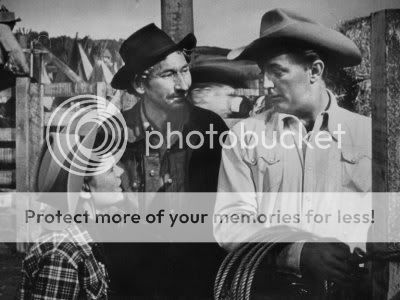 In The Lusty Men, Nicholas Ray anticipates the concise metaphor of the chicken run in Rebel Without a Cause with an entire two hours worth of suspense over a character’s choice to either jump early or ride to the death. It’s the fatalistic masculine ritual of the rodeo, and Ray explores it from several angles—thrill-seeking as metaphysical rush, danger-seeking as a quick route to fame and profit, and glory-seeking as male self-absorption. Robert Mitchum plays Jeff McCloud, a washed up rodeo star who partners up with Wes Merritt, played by Arthur Kennedy, a ranch-hand eager to make it big as a rodeo star himself. Susan Hayward plays his wife, Louise, in one of the most touching, understated female performances I’ve ever seen. Just about the only clearly thinking character the whole way through, Louise embodies Ray’s feminist leanings in her sympathetic foiling against the absurdity of macho ritualism. Ray never misses an opportunity to expose Wes for his misogynistic hypocrisy, lashing out at Jeff for mooching off his winnings while failing to acknowledge his own thankless dependence on his wife’s assumed domesticity and pleasuring himself with nightclub women without a blow to his conscience before hostilely confronting Jeff for kissing his wife.
If Wes is a brutish fame-seeker who becomes delusional about his rodeo skills and gambles away his winnings, then Jeff is harder to pin down, a wistful, tired-out man who exemplifies the lightly glimmering romance of the rodeo-circuit with all his failures behind him and who, like Dixon Steele and Jim Stark, desires some sort of family. He is seen at the beginning trekking in long shot through a rodeo graveyard and soon after goes to his childhood home in search of old belongings. It is one of my favorite Mitchum performances, confident and fragile and plaintive, and the ways Ray uses his depth of space to place him in various approximations to the other characters—triangularly in the context of Wes and Louise’s marriage and diametrically with Wes, his relationship to either ever in flux—gives the film an enrapturing formalism. The broader, poetic undertones erupt full-force when Jeff’s hard, masking exterior is shed to reveal his selfless, romantic motives and he rides off to a grand finish in a final spurt of his former glory—a heroic sacrifice, a tragic ode to what could have been between him and Louise, and a grand assertion of immortality.
“There never was a bronc that couldn't be rode, there never a cowboy that couldn't be throwed. Guys like me last forever.”
Subscribe to:
Posts (Atom)